

Thanks to your hard work, we've taken a historic step forward on the journey towards better human rights protection in SA
On 29 April 2025 the Social Development Committee of the South Australian Parliament tabled its report following a 16 month Inquiry into the Potential for a Human Rights Act for South Australia.
The Report recommends that the South Australian Government:
- consolidate the various rights and protections afforded to citizens into one comprehensive Human Rights Act for SA.
- transition the Equal Opportunities Commission to a Human Rights Commission.
- conduct a comprehensive consultation with the South Australian Community on the model of Human Rights Act to be adopted.
Read the full report of the Social Development Committee here
Read our joint media release here
Read a summary analysis of submissions received to the Social Development Committee below or download a PDF here
What's Next?
Over the coming months HRA4SA will be seeking meetings with members of the South Australian Parliament to discuss the report.
We will also hold an online workshop to ensure that everyone can participate in building positive momentum toward the SA Government implementing these historic recommendations in full.
Through a strong alliance of community members we can succeed in creating a fairer South Australia where everyone is treated with dignity, equality and respect.

What did South Australians tell the Inquiry?
Read the HRA4SA campaign group submissions here:
- Rights Resource Network (RRNSA)
- Australian Lawyers for Human Rights (ALHR)
- South Australian Council of Social Service (SACOSS)
The Committee received 147 written submissions and held 12 oral hearings

An overwhelming number of submission makers (88%) expressed support for the enactment of a Human Rights Act in South Australia. This is consistent with (indeed slightly higher than) the levels of support reported in the 2009 Brennan report at 87.4% and the 2023 AHRC Free and Equal report at 83%.
- 45% mentioned the International Covenant on Civil and Political Rights (ICCPR)
- 37% mentioned the International Covenant on Economic, Social and Cultural Rights (ICESCR),
- 17% mentioned the Convention on the Rights of the Child (UNCRC)
- 14% mentioned the Convention on the Rights of Persons with Disabilities (CRPD)
- 10% mentioned the UN Declaration on the Rights of Indigenous Peoples (UNDRIP).
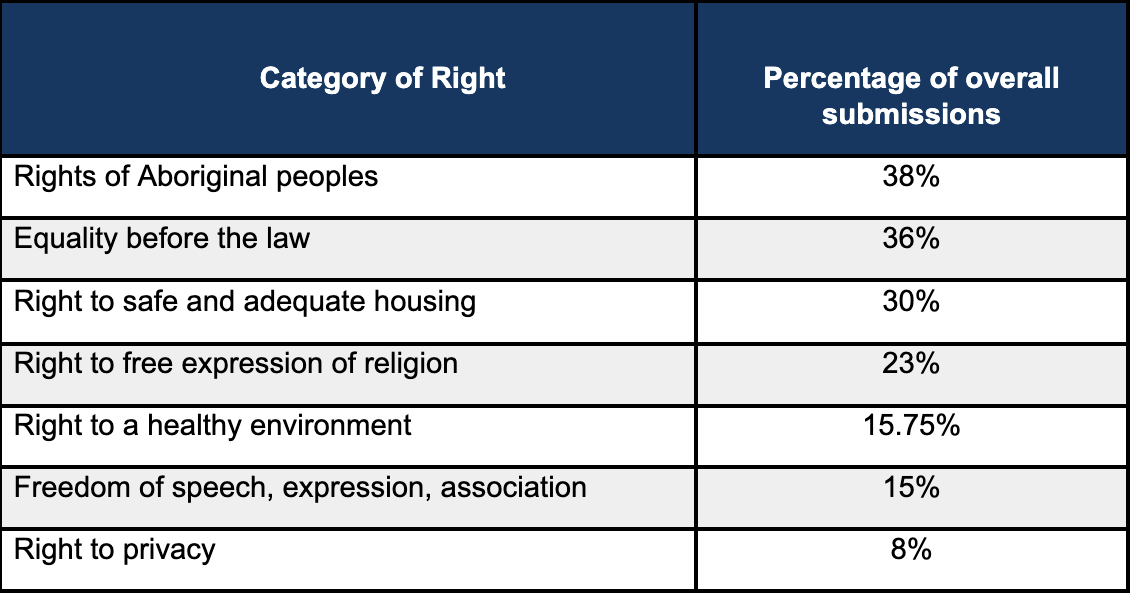
|
SNAICC (National Voice for Aboriginal and Torres Strait Islander children): “… the existence of a South Australian Human Rights Act will create a culture of valuing and prioritising human rights in public policy. These requirements and cultural changes will help prevent breaches of Aboriginal and Torres Strait Islander children’s rights.”SNAICC |
|
Saint Vincent De Paul: “Access to adequate housing can be a precondition for the enjoyment of several human rights, including the rights to work, health, social security, vote, privacy, or education.’ “A fundamental purpose of South Australia's human rights legislation should be to integrate a culture of rights awareness and observance across the broader community, and among key government service providers and decision makers |
|
Natalie Wade: “People with disabilities face disproportionate levels of violence, abuse, neglect and exploitation, have significant barriers to access justice and continue to be forced into segregated settings at school, work and in housing. This a nationwide issue and South Australia is no exception. This is an unacceptable approach and must be changed. A Human Rights Act would see a proactive approach to creating better outcomes for people with disabilities.” |
|
LELAN (SA Lived Experience and Leadership Network): A Human Rights Act would “[r]ecognise and protect the rights of individuals, including people with lived experience of mental distress and psychosocial disability, to legal representation in relation to any limit to human rights that can be applied by law, government or other agencies including decision-making capacity hearings, guardianship and involuntary treatment orders.” |
|
Submission 56 highlights the submitter’s experience navigating the aged care system, and how a human rights act could contribute towards positive change in this sector. “My Dad recently passed away last August after suffering from complications related to advanced Parkinson’s and Alzheimer’s diseases in an aged care facility. … We had to witness the decline in the quality and quantity of food provided, the little extras like afternoon tea disappear, the numbers of carers and nursing staff to patient ratio decline to dangerous levels. … The Aged Care Charter had no legal teeth. It was pure rhetoric for us to defend Dad’s rights, and the rights of the other residents. It offered no recourse for a cause of action, resolution or remedy. However, as part of a Human Rights Act (SA), there would be the capacity for those who have had their rights removed, ignored, silenced, or violated, to stand up and have their voice heard in court where the benefit would be widespread and restore dignity, at the very least, to those who were once voiceless and invisible.” |
|
The Uniting Church: "several of our congregations run Emergency Relief Centres and provide food and support weekly. Demand has increased throughout 2023 and supply of food is getting harder to source." The UC submission says that a Human Rights Act would help to: “build a fairer society, [where] all South Australians should have their human rights clearly and unambiguously enunciated, promoted, and enshrined in law.” |
|
The Aboriginal Legal Rights Movement: identified a lack of Aboriginal interpreters (particularly in the context of legal matters and health settings) as a priority human rights concern, that negatively impacted a range of internationally protected rights including freedom from arbitrary deprivation of liberty, minimum guarantees in criminal proceedings’ and cultural rights. |
|
The Conservation Council of South Australia: A Human Rights Act should include a right to a clean and healthy environment Doctors for the Environment: “[r]educing environmental injustice is particularly important for people who are already experiencing disadvantage, marginalisation or disempowerment, as they are more susceptible to the risks of climate change”. |
|
The Public Law and Policy Institute at the University of Adelaide: A Human Rights Act would: “generate a more robust rights culture within the parliament by requiring legislators to assess all bills at the time of drafting and enactment for their rights implications. In other words, it asks politicians to wear ‘rights tinted glasses’ when undertaking their legislative duties. Within such an arrangement, rights are injected into the very heart of the operations of parliament.” |
|
The Aboriginal Health Council: discussed the benefits of a Human Rights Act as prompting governments to consult communities early in the lawmaking process: “The challenges currently faced highlight the inadequacy of current systems, exposing the ongoing discourse and need for change and reform. Shifting the policy focus from crisis response to a proactive human rights approach is important for all South Australians especially the most marginalised in our community.” |
|
Submission 52: “[r]ights-enhancing laws and policies that have been subject to meaningful community and expert consultation save resources because they are more likely to achieve their stated policy aims, and less likely to have unintended consequences or disproportionate impacts on certain groups within our community. When laws and policies are made in the absence of these key features, or when causes of injustice or inequality go unattended in our community, the economic costs can be significant.” |
Read all submissions made to the SDC inquiry here
Make a Submission to the Parliamentary inquiry into a Human Rights Act for South Australia by 16th February 2024!
South Australia is one step closer to a Human Rights Act, with the Social Development Committee of the South Australian Parliament currently holding a parliamentary inquiry into how human rights across the State can be guaranteed and protected. This is an historic opportunity to tell our parliamentarians that we want our state to legally protect human rights for all South Aussies.
We need as many people and organisations as possible to make a submission to the review. We are here to support you to make your voice heard!
Simply combine information from the below resources with your expertise, lived experience or personal views in order to ensure the Committee receives lots of compelling submissions from the community in support of a Human Rights Act for SA.
Submissions are due by 5.00pm on 16th February 2024 and should be sent to: [email protected]
Step 1: Remember these key submission writing tips
➢Explain who you are and why human rights are important to you.
➢Respond to the terms of reference
a) the effectiveness of current laws and mechanisms for protecting human rights in South Australia and any possible improvements to these mechanisms;
b) the operation and effectiveness of human rights legislation in other jurisdictions;
c) the strengths and weaknesses of adopting a Human Rights Act in South Australia;
d) the potential human rights protections in any act;
e) the potential implications of any act for the making of laws, courts and tribunals, public authorities and other entities;
f) any other related matters.
➢Be specific to your issues – you don’t need to address all terms of reference, or legal technicalities, or all human rights – speak to the rights most important to you.
➢Real-word examples will shine through.
➢No need to re-invent the wheel – speak from experience, and up-cycle existing annual reports, submissions etc.
➢It doesn’t need to be long - even submissions of a few pages ban be powerful and compelling!
Step 2: Use our easy submission template and adapt it to suit your priorities:
-
HRA4SA submission template: Inquiry into the Potential for a Human Rights Act for South Australia (WORD)
Step 3: check out these resources and see if they help with writing your submission:
-
Time for a HRA4SA: Submission Writing Workshop Slides
-
Plain English Briefing on a Human Rights Act for SA
-
Case Studies that show how the Human Rights Acts in QLD, Victoria and the ACT are benefitting different groups
-
Rights Resource Network Submission to Inquiry into the Potential for a Human Rights Act for South Australia December 2024
-
150+ organisations and experts sign our joint statement: 'Proposing a Human Rights Law for South Australia'
-
Human Rights Act Explainer
-
Designing a Human Rights Framework for South Australia Final Report February 2022
-
SACOSS Policy on a Human Rights Act for SA
-
Law Society of South Australia Policy on a Human Rights Act for SA
-
2022 Election Scorecard: Human Rights Act for South Australia?
-
101 Cases Report: How Charters of Human Rights are Making Our Lives Better, Human Rights Law Centre
Step 4: email your submission to [email protected] by 5pm on 16th February 2024
Do you like this page?